A beautifully planted garden can disappear entirely after sunset if its lighting is treated as an afterthought. Thoughtful garden wall light placement gives terraces, pathways and exterior walls a warm architectural presence, while making the journey from the house to the garden feel safer and more inviting. The aim is not to flood every surface with brightness. It is to compose pools of light that flatter the materials, frame the view and make evenings outdoors feel considered.
For a refined exterior scheme, begin with how the garden is used after dark. A wall beside the back door needs practical clarity. A long rendered boundary wall may call for rhythm and atmosphere. A secluded dining terrace deserves a softer, more flattering glow. When each fitting has a purpose, the overall effect feels quietly luxurious rather than overlit.
Garden Wall Light Placement Starts With Purpose
Before choosing a finish, shape or bulb temperature, stand outside at dusk and trace the routes people actually take. Consider the entrance from the house, steps, gates, seating areas, outdoor kitchens and the route to a shed or garage. These are the places where lighting earns its place.
Functional positions should be illuminated first. Place wall lights beside exterior doors to make keys, handles and thresholds visible, and use fittings near changes in level to reduce the risk of a missed step. Once these areas are resolved, add decorative lighting where it will create depth: along a garden wall, near a sculptural tree, or beside a seating nook that deserves to feel like an outdoor room.
This distinction matters because the brightest light is not always the most useful. A powerful fitting mounted directly opposite a seating area can create glare, while a lower-output design placed close to the door may provide better visibility. Luxury is often felt in the restraint of the lighting plan.
The Right Mounting Height for Outdoor Wall Lights
For most entrances, install a wall light with its centre around 1.65 to 1.8 metres above finished ground level. This places the fitting near eye level for most adults, gives an entrance a balanced proportion and directs light where it is needed without creating an uncomfortable hotspot.
At a back or side door, the best height also depends on the fitting itself. Tall lantern-style wall lights need more breathing room than compact contemporary cylinders. If a fixture is mounted too high, it can look disconnected from the doorway and cast light too broadly. Too low, and it can become visually crowded by furniture, planting or passing guests.
For a pair of lights flanking a door, align their centres at the same height and leave enough width for the door frame to read clearly between them. On a narrow wall, one well-chosen fitting above the door may look more elegant than two squeezed into the available space. Symmetry is desirable, but proportion should lead the decision.
Steps, gates and lower boundary walls
Low-level wall lights are particularly effective beside steps and along retaining walls. Install them roughly 30 to 60 centimetres above the finished surface, depending on the design and the wall height. Their role is to reveal the edge and direction of travel, not to shine into someone’s face.
At a gate, position a fitting so it illuminates the latch and the approach rather than the person standing at it. A downward-facing fixture is often the more comfortable choice. If a gate opens onto a public pavement or neighbouring property, take particular care to shield the light and avoid spill beyond your boundary.
How Far Apart Should Garden Wall Lights Be?
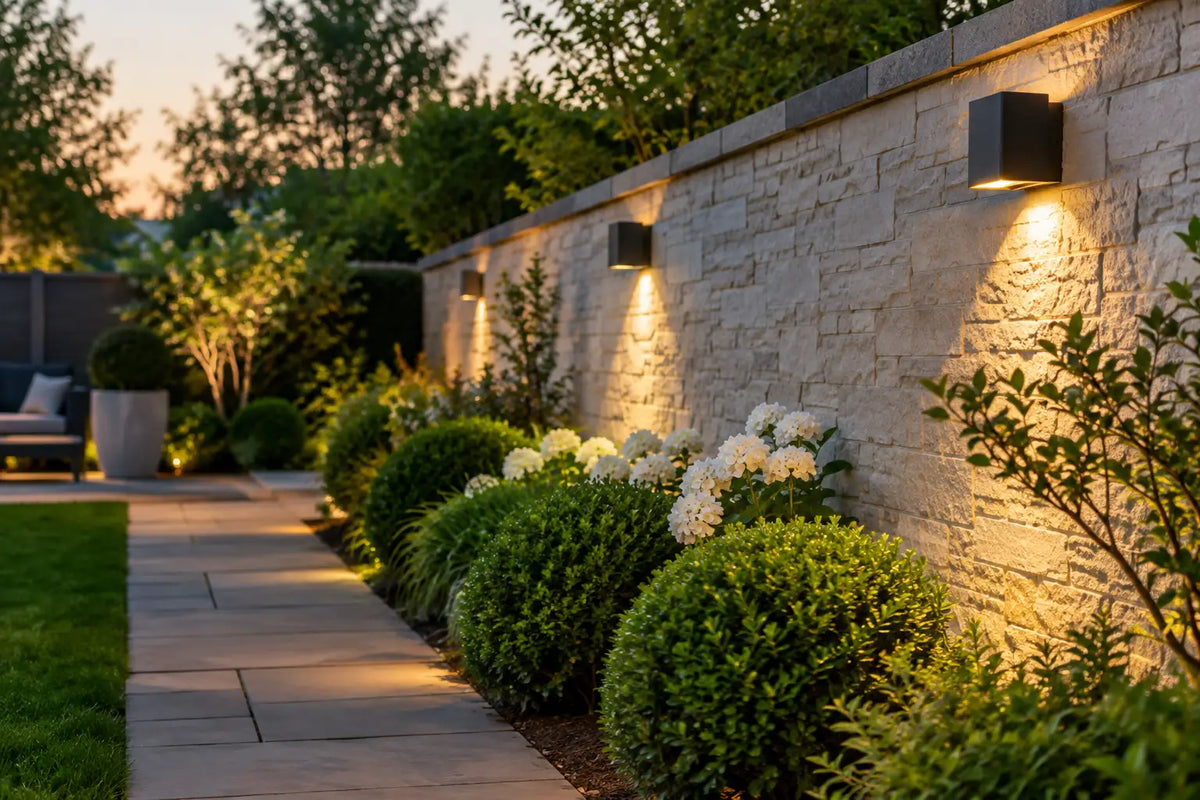
Spacing is where garden wall light placement becomes less about a fixed measurement and more about the beam pattern, wall finish and desired mood. As a starting point, place decorative wall lights around 2.5 to 4 metres apart on a long wall. This usually creates overlapping pools of light without turning the garden perimeter into a runway.
The exact distance changes with the fitting. Up-and-down lights create strong vertical columns that can look dramatic on brick, stone or textured render, but their pattern is more distinct. They may need wider spacing to avoid a repetitive striped effect. Lanterns with diffused glass produce a broader, gentler glow and can sit a little closer together when the goal is even ambient light.
Do not assume every wall needs identical intervals. A patio wall may benefit from a pair of lights centred around a dining table, while the far end can remain intentionally darker to preserve a sense of depth. On a lengthy boundary, irregular architectural features, mature climbers and planting beds can provide natural pause points. Allow the lighting to respond to the garden rather than forcing it into a grid.
Match the Fitting to the Wall and the Light to the Mood
Outdoor wall lights should feel coherent with the property’s architecture. A black or bronze lantern brings timeless elegance to brick façades, traditional garden rooms and period-inspired terraces. Slim matt-black cylinders and geometric designs suit clean-lined extensions, porcelain paving and contemporary rendered walls. For a more decorative statement, glass and metal fittings can add a jewel-like note beside French doors or a covered entertaining area.
The direction of light deserves equal attention. Downlights are excellent near doors, gates and steps because they concentrate illumination below eye level. Up-and-down wall lights bring texture and height to a plain façade, particularly where the wall material has character worth revealing. A shaded or frosted-glass fitting softens the source itself, making it especially appealing beside outdoor seating.
Choose warm white light, generally around 2700K to 3000K, for residential gardens. It enriches timber, brick and foliage, while feeling more welcoming for dining and relaxing. Cooler white light can appear stark against planting and may make an otherwise exquisite exterior feel more commercial than considered.
Consider glare from every seat
A fitting can look perfect when viewed from the kitchen yet feel intrusive from the terrace sofa. Sit in the places where people will linger and check whether you can see the bare lamp or a harsh reflection in glazing. If so, move the fixture, change the beam direction or select a design with better shielding.
Glare is particularly common on pale rendered walls and polished paving, which bounce light back into the garden. Dark brick, timber cladding and dense planting absorb more light, so they may need slightly more output. This is why identical fittings do not perform identically from one garden to another.
Plan for Weather, Wiring and Control
Every exterior wall light must have an IP rating suitable for its position. Exposed elevations need stronger weather protection than covered porches, and coastal locations can demand corrosion-resistant materials as well as an appropriate IP rating. Look for durable finishes and sealed construction that will retain their appeal through rain, frost and changing seasons.
Wiring should be planned early, ideally before new walls are rendered or a patio is finished. Concealed cables create the cleanest result, but a qualified electrician can advise on safe solutions for existing gardens. Exterior electrical work should never be improvised. It is a small investment in safety and the long-term performance of the scheme.
Controls transform how the garden feels to use. A switched circuit suits a simple entrance, while timers ensure a welcoming glow at the times you return home. Dimmers offer the most flexibility on a dining terrace, allowing brighter light for serving food and a lower, more atmospheric setting later in the evening. Motion sensors can be useful by side passages and utility doors, though they are less suited to a relaxed entertaining zone where sudden brightness can spoil the mood.
Create Layers Instead of Lighting Everything
Wall lights work best as part of a layered exterior composition. Let them establish the vertical structure of the garden, then use discreet path, spike or deck lighting only where it adds another useful dimension. The wall lighting may frame the terrace, while a gentle uplight reveals a specimen tree beyond it. The result feels more spacious because the eye is drawn through the garden rather than stopped at the nearest wall.
Resist the temptation to illuminate every boundary and planting bed. Darkness is part of the design. It gives the brighter elements contrast, preserves privacy and allows the garden’s most beautiful features to take the lead. A few well-positioned fittings will always feel more expensive than a crowded collection of competing lights.
For an elevated finish, choose outdoor wall lights with the same care you would bring to a chandelier or statement pendant indoors. The best placement lets the fixture complement the architecture by day, then shape a warm, memorable garden atmosphere long after the sun has gone down.